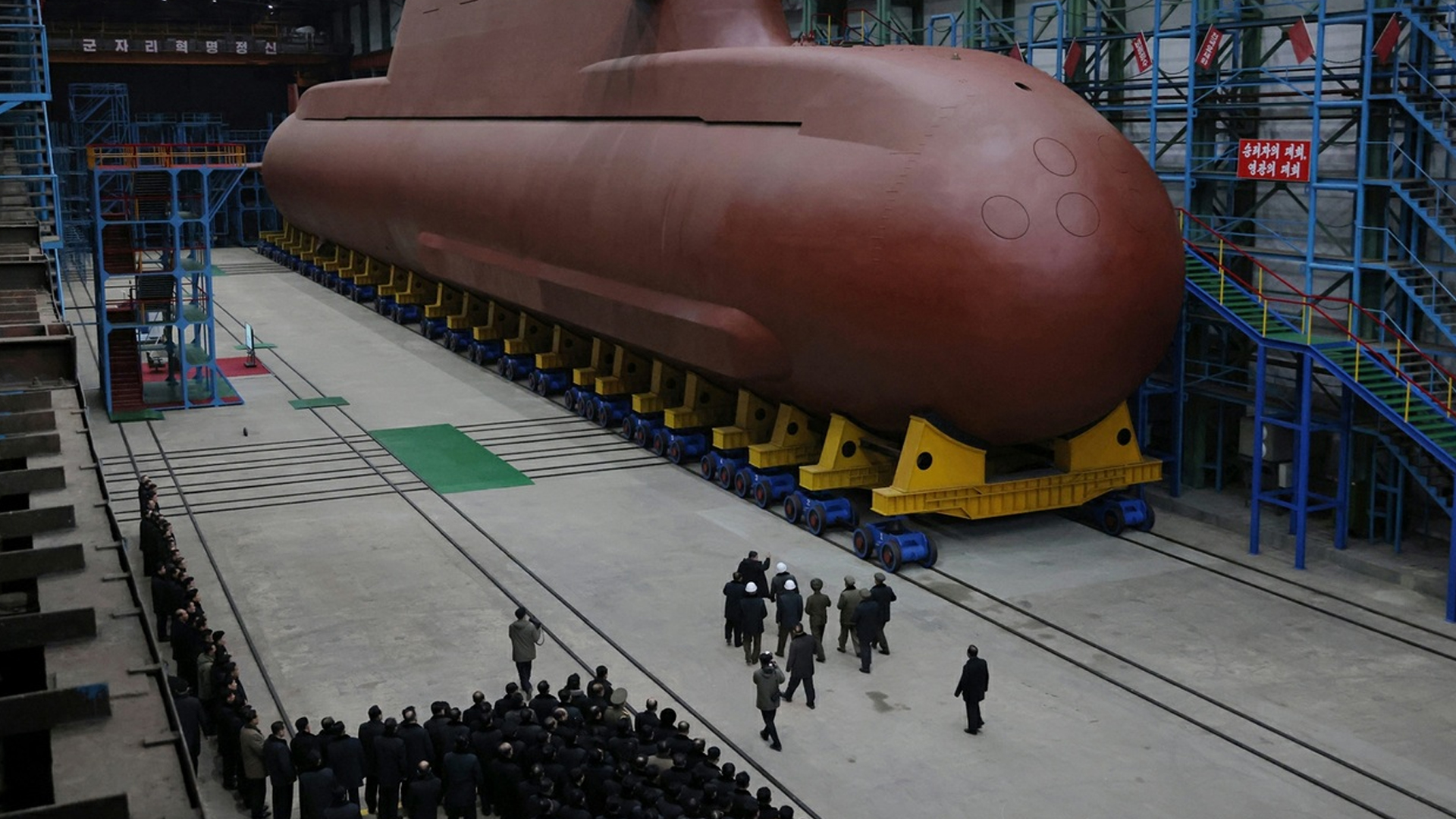
North Korea has publicly revealed significant progress on its first nuclear-powered submarine, showcasing an 8,700-ton vessel at a shipyard and marking a milestone in its military modernization program. State media released images of leader Kim Jong Un inspecting the largely completed submarine, which is described as a “strategic guided missile submarine” intended to bolster the country’s nuclear deterrent and naval capabilities.
Photographs published by the Korean Central News Agency (KCNA) show the submarine’s hull inside an assembly hall, suggesting that many internal systems, including the nuclear reactor and propulsion components, may be nearing installation. Experts note that while the hull appears advanced, operational readiness, including sea trials and weapons testing, could take several years. Some analysts speculate that Pyongyang may have received external technical support, possibly from Russia, although no independent verification exists.
During the inspection, Kim Jong Un was accompanied by senior officials and his daughter, Ju Ae, whose public appearances have fueled speculation about her potential future role. Kim criticized South Korea’s plans, supported by the United States, to develop its own nuclear-powered submarines, calling them a “threat to security” and an “offensive act” infringing on North Korean sovereignty.
State media hailed the submarine project as an “epoch-making” achievement, part of a broader military push that includes advances in ballistic missiles, long-range air defense systems, and other strategic weaponry. North Korea’s leadership emphasized that the vessel is crucial for strengthening the country’s nuclear and naval capabilities.
International analysts, however, caution that while the hull’s appearance indicates progress, the country’s ability to deploy a fully functional nuclear-powered submarine remains uncertain under the weight of international sanctions. No independent verification has confirmed the submarine’s nuclear propulsion or weapons systems.
The announcement comes amid escalating tensions on the Korean Peninsula, with both North and South Korea advancing submarine and missile technologies. Analysts warn that this development could contribute to a renewed arms buildup in East Asia, intensifying regional security concerns.
This unveiling highlights Pyongyang’s continued focus on military self-reliance and signals its intent to maintain a credible nuclear deterrent at sea, further complicating international diplomatic efforts in the region.
Also Read: US targets Islamic State militants in northwest Nigeria