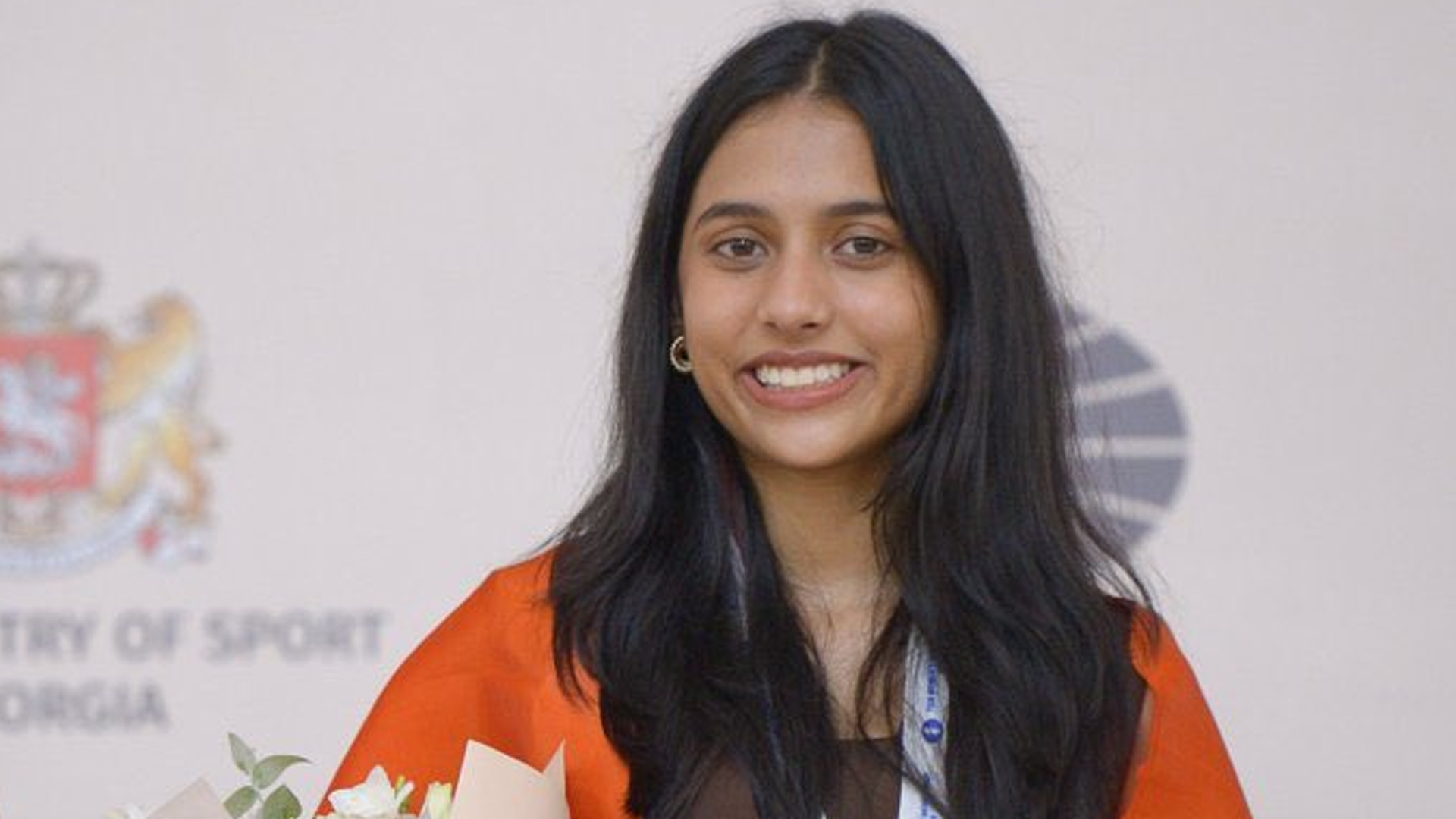
At just 19, she has rewritten the record-books in Indian and world chess. Her journey from just another Nagpur girl to becoming India’s first to win the FIDE Women’s World Cup is a story of talent, grit and discipline.
By Bhavya Narayan
Nagpur wakes before sunrise. The streets are quiet, the monsoon still hanging in the air drips from trees. In the modest home in Shankar Nagar, Divya Deshmukh, 19, is already awake, reviewing games on her laptop.
It is not unusual. Over recent months, her life has shifted from the simple routines of school and local tournaments to the roaring applause of world stages. But even as she becomes one of India’s brightest chess stars, there remains in her a humility that belies what she has already achieved.
Divya Deshmukh was born in December 2005 into a family of doctors. From an early age, her parents encouraged curiosity—whether in studies or strategy. Chess, with its 64 squares and 32 pieces, became the framework through which impatience was disciplined, risks were measured, and victories—both large and small—became the stepping stones of belief.
In September 2024, at the 45th Chess Olympiad in Budapest, she signalled her arrival. Playing on India’s third board, she scored 9½ out of 11, with a performance rating above 2600. India won the Women’s event gold for the first time. It was a defining moment—not only for the nation but also for Divya, who had begun to understand what it meant to bear expectations.
Then July 2025 arrived, and with it, Batumi. The FIDE Women’s World Cup in Georgia proved to be both theatre and trial. Divya, seeded only 15th, dispatched higher-rated adversaries, among them Zhu Jiner in the fourth round and Tan Zhongyi in the semi-finals. In the final, she faced veteran Koneru Humpy. Two classical games ended in quiet tension, draws. In the rapid tiebreaks, Divya exploited mistakes, held her composure—and, in doing so, not only won the tournament but earned the Grandmaster title, making her the fourth Indian woman ever to do so.
After that, the media labels came fast: “overnight sensation,” “India’s next big thing,” “golden era of Indian chess.” Yet she responded in interviews that what seems overnight is really years of study—of losing, analyzing losses, and making mind-games as important as the moves on the board. She admitted that the pre-game rituals—her “lucky kurta,” a specific playlist (“Mary Kom” songs, among others), and routines before stepping into the arena—are less superstition than anchors, stabilizers for nerves.
Her return to Nagpur after Batumi was nothing like returning home. Thousands thronged the streets, motors sounded, banners waved. There was a roadshow, gifts, a steady stream of felicitations. In conversation, she described the mix of surprise and joy that came with recognition—not just from the chess establishment but from neighbours, strangers, from young girls who approached her to say, “I want to do what you are doing.”
Since that World Cup victory, Divya has not slowed. At the FIDE Grand Swiss 2025 in Samarkand, she stunned Egypt’s top‐ranked grandmaster Amin Bassem, playing black, with an assertive, tactical game that many analysts have praised for its clarity under pressure. Shortly after, in a legendary endgame against fellow Indian and childhood buddy D. Gukesh, the reigning World Champion, she drew after 103 moves.
The richness of those games is not only in heralding her but also in cementing that she can match the best in the open field, not just among women.
What sets Divya apart is not simply her wins—it is how she wins. In an interview with India Today, she said she studies sports psychology and data analytics—to understand not just what move to make, but how other players react under time pressure and what nerves look like in a match. Her opening preparation is sharp, yes, but even more so her readiness for the emotional swings that come with knockout formats. She tries to remain calm, to let the board speak.
Yet even Divya acknowledges that the journey ahead will test different muscles. Qualifying for the Women’s Candidates Tournament in 2026 is now her next big goal. There will be more travel, more tournaments with higher stakes—and the pressure will be more continuous. She has spoken privately of fatigue—the strain on mind and body that comes with constant preparation. She plans to balance studies with chess more deliberately now. There’s talk of online courses and keeping academic options open.
Divya Deshmukh’s rise is more than personal glory—it is part of a larger narrative. Indian chess over the past few years has seen a surge. Young men like Gukesh Dommaraju, R. Praggnanandhaa and Arjun Erigaisi are regularly in the world’s top echelons. In a country where cricket has long been the unrivalled sport of mass following, chess is beginning to stake its claim to a similar space in the public imagination. Divya’s win, in this sense, is a crack in ceilings that once seemed thick—that women’s chess could win big, that players from outside the usual elite centres (Delhi, Mumbai, Bengaluru) could reach global heights, that young girls could expect to compete without apology.
In Nagpur, parents say her example shifts mindsets—their daughters can compete, their daughters can travel alone, their daughters can dream of Grandmaster titles. Chess academies in smaller cities are seeing pick-ups in enrolment—and tournaments outside the traditional metropolises are getting better sponsorship. Divya herself has become not just a symbol, but in some ways a catalyst.
When she spoke of dealing with “overnight fame,” she did not sound daunted. She laughed about social media tags, about people telling her she is “India’s chess future.” She said, yes, those are flattering—but her focus remains inward—each tournament, each move, each error to be corrected, each opponent to be studied.
For all the celebrity, the medals, the GM title, there is still the board. And for Divya, rising means understanding what appears next—maybe deep runs in mixed or open events, maybe breaking into the overall World Top 50 across both genders, perhaps someday challenging for the Women’s World Championship title. As the late nights studying, the travel, the sacrifice—all accumulate, one senses that what she is building is not just a career—but a legacy—both on and off the board.
Also Read: Sushila Karki Appointed Nepal’s First Woman Prime Minister Amid Political Crisis