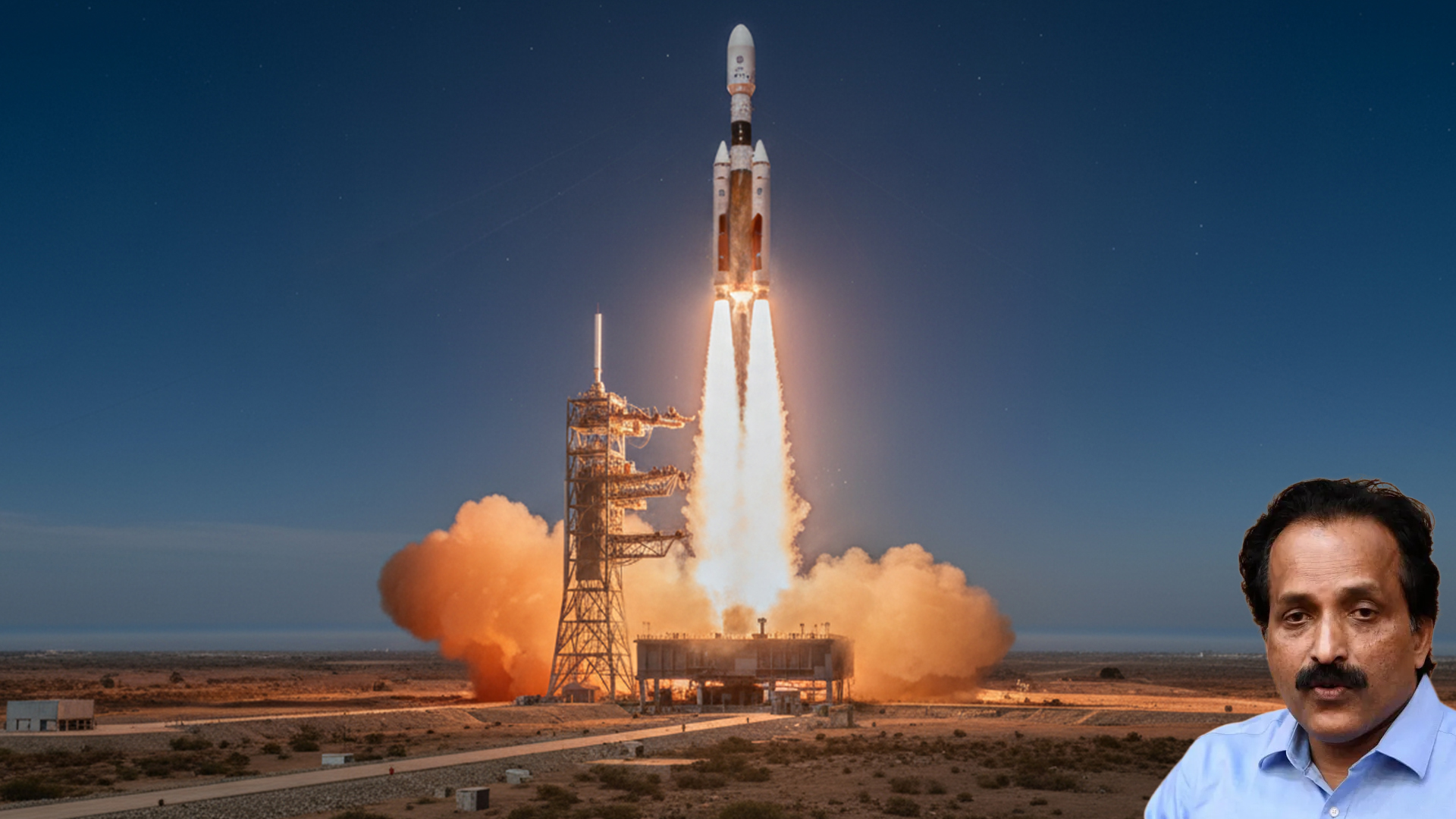
India’s space ambitions soared higher on Saturday as the Indian Space Research Organisation (ISRO) successfully launched its heaviest communication satellite, CMS-03, aboard the LVM3-M5 rocket, also fondly called “Bahubali”, from the Satish Dhawan Space Centre in Sriharikota.
The 43.5-metre-tall launcher lifted off at 5:26 p.m., carrying the 4,410 kg satellite into a Geosynchronous Transfer Orbit (GTO). CMS-03, built to deliver multi-band communication across UHF, S, C, and Ku frequencies, will significantly enhance secure connectivity for India’s defence, maritime, and disaster-management operations.
ISRO Chairman Dr. S. Somanath described it as a proud leap in indigenous heavy-lift technology. The LVM3-M5 demonstrates India’s capability to deploy large satellites without relying on foreign launchers. The rocket’s three-stage configuration, comprising solid boosters, a liquid core, and a cryogenic upper stage, was fully developed and assembled within India.
The space industry hailed the success of the LVM3-M5 mission, calling it a milestone for India’s self-reliant space capability. The Indian Space Association (ISpA) and Satcom Industry Association-India (SIA-India) congratulated ISRO, noting the growing role of private partners in building critical subsystems. Lt Gen (Retd.) Anil K. Bhatt, Director General of ISpA, described the launch as “a monumental achievement” that strengthens India’s strategic and maritime communications network
This success strengthens India’s strategic communication infrastructure and positions LVM3 as the preferred vehicle for upcoming missions, including the Gaganyaan human spaceflight programme. Orbit-raising manoeuvres in the coming days will position CMS-03 in its final slot over the Indian Ocean Region, where it will begin operational service.